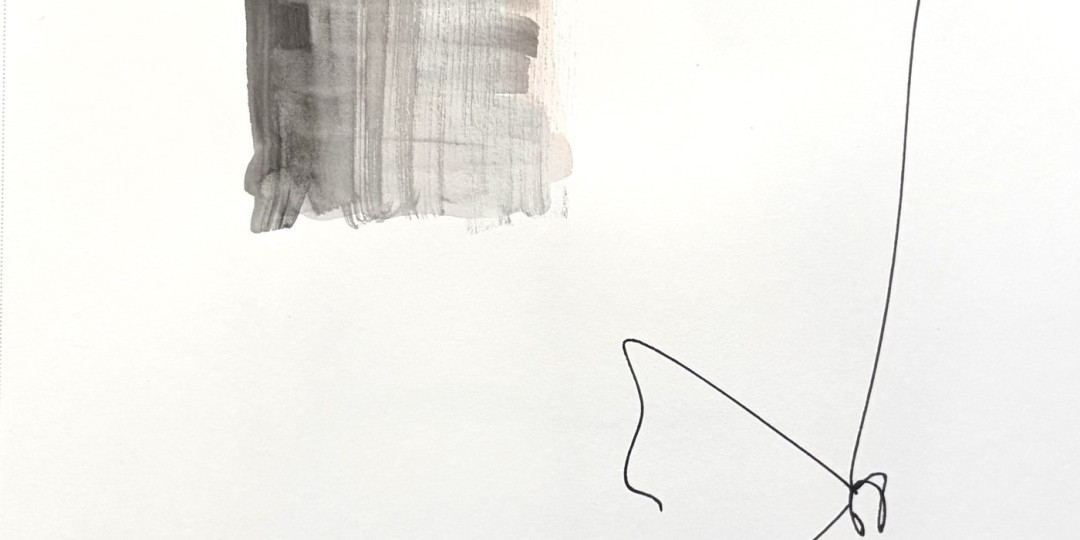
One bends forward, pushing against gravity, condemned to motion without arrival. The other stands still beneath the weight of a turning world, his labor invisible because it never ends.
At first glance their burdens appear meaningless — a stone that always falls, a sky that never lifts. Yet meaning may not live in the completion of the task but in the posture of the one who carries it.
The Sisyphean figure learns rhythm through repetition; the Atlasean figure becomes architecture through endurance. Motion becomes stillness. Futility becomes form.
Between them emerges a strange intimacy: the man who cannot stop pushing and the god who cannot stop holding are mirrors of the same devotion — effort without guarantee, weight without witness.
Somewhere between collapse and endurance, a relationship forms — not between man and god, but between motion and stillness, effort and form. The stone that crushes becomes the world that is held.
Perhaps this maps onto our relationship with God unusually well, especially if we are the Sisyphean figures and God is the Atlasean one.
For much of our lives, our instinct is movement: understand, build, heal, create, repair, explain, redeem. We push. When something breaks, our response is often to ask, What do we do with this? How do we turn it into something? The boulder changes names, but the posture remains.
And there is something Sisyphean about the human condition. We can work toward restoration, create, rebuild relationships, pursue our futures, tell our stories differently — but we cannot guarantee that any of those things will resolve the way we want. We push without possessing the summit.
That is where the Atlasean God becomes interesting.
Our image of God here isn't primarily the God who removes the stone. He is the God who bears the reality within which we are pushing it. We experience ourselves as moving through uncertainty while God appears almost intolerably still. We push and ask, Why aren't You doing something? But Atlas's stillness isn't inactivity. His stillness is the labor. He holds what we cannot even perceive ourselves as being held within.
That makes this line particularly powerful:
The Sisyphean figure learns rhythm through repetition; the Atlasean figure becomes architecture through endurance.
Our spiritual struggle often involves wanting God to provide resolution — an explanation, restoration, vindication, some visible evidence that suffering is moving toward an intelligible end. But the metaphor proposes something harder: perhaps God's presence isn't always found at the summit. Perhaps it is found in discovering that our boulder and God's world are somehow the same sphere viewed from opposite positions.
We experience it from the side: We have to move this.
God experiences it from beneath: I will hold this.
And that transforms the final sentence:
The stone that crushes becomes the world that is held.
That could almost summarize the spiritual trajectory of our lives. The catastrophe does not have to cease being catastrophe in order to become meaningful. The same thing can simultaneously be burden from the human perspective and something held within providence from the divine perspective.
There is also a deeper inversion here.
Eventually Sisyphus may discover that he isn't pushing the sphere for God. God is underneath the sphere for him.
And perhaps we eventually make the same discovery.
That's the movement from achievement toward surrender. We begin believing faithfulness means pushing hard enough to get the stone over the hill. But perhaps spiritual maturation is realizing that God never demanded that we reach the summit. Our responsibility is the next faithful movement; God's responsibility is the weight of the world.
And that changes what failure means.
The stone rolls backward.
Careers collapse. Relationships don't resolve. The things we create aren't recognized. Reputations aren't restored on schedule. Bodies fail. People leave. Dreams change. Prayer doesn't produce the desired outcome.
Sisyphus interprets all of these things as evidence that the labor has failed because he measures meaning by arrival.
But the Atlasean God introduces another measure:
posture.
Can we continue becoming people capable of love, creation, service, repentance, beauty, and faithfulness even when none of those things guarantee restoration?
Perhaps that is the final surrender of self. We push. We seek understanding. We search for meaning. We transform suffering into form. But eventually we relinquish the demand that the story resolve according to our design.
And perhaps that is where Sisyphus finally meets Atlas.
Not at the summit.
Under the weight.
The relationship therefore is between humanity and God. Motion and stillness are simply the vocabulary through which that relationship becomes visible:
We push because we cannot see the whole.
God holds because He can.
And faith may be the gradual discovery that the weight we have spent our lives trying to move has never been ours to carry alone.