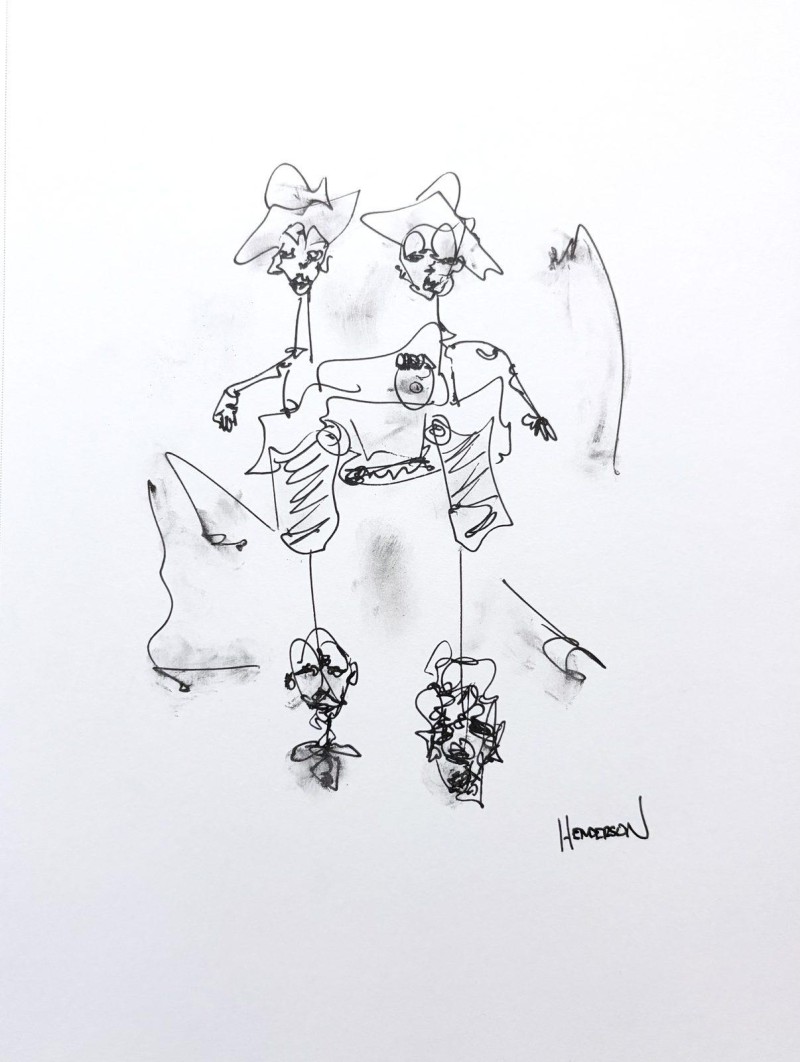
Near the end of his life, Albert Camus wrote a short story about a painter named Jonas. Jonas is a man who succeeds — his work is admired, his studio fills with visitors, his life fills with obligations — until the noise of being wanted becomes so constant that he retreats. First behind a curtain in his own studio. Then into smaller and smaller corners of his house, until he is working from a narrow platform tucked into a hallway, hidden from the very people who love him.
When his friends finally find him, they find a canvas. Almost blank. In the center, a single word, written so small and so faintly that no one can agree on what it says. Some read it as *solitaire* — solitary. Others read it as *solidaire* — solidary, bound to others. Camus never resolves it. That's the point. The word was never meant to be legible. It was meant to be true.
The tension nobody gets to opt out of
I've spent most of my working life sitting with people trying to make sense of themselves — first as a psychiatrist, now as a painter doing much the same work with a different set of tools. And if there's one pattern I've watched play out again and again, in myself and in nearly everyone I've sat across from, it's this exact one. The pull toward solitude, where a person can finally hear their own thoughts without interference. And the pull toward solidarity, the need to be known, to be part of something, to not carry it all alone.
Neither pull wins. Neither pull is supposed to win.
An artist who only withdraws produces work that speaks to no one — technically accomplished, maybe, but sealed off, a private language. An artist who only performs for an audience produces work that says nothing at all, because it was never really theirs to begin with; it was shaped entirely by what they thought other people wanted to see. The paintings that actually last — the ones that unsettle you in a way you can't quite name — tend to come from someone who has been alone long enough to find something true, and brave enough to bring it back into the room.
Why this isn't just an artist's problem
I don't think this tension belongs to artists alone, though artists tend to feel it most acutely because their solitude is visible — it has a studio, a closed door, a canvas nobody else is allowed to touch yet.
Anyone rebuilding themselves after a period of real difficulty knows this same pull. Recovery, in almost any form it takes, asks a person to do serious, often uncomfortable work alone — to sit with themselves without the old noise, the old distractions, the old ways of not-feeling. That solitude is not optional; it's where the actual change happens. But recovery that stays entirely solitary tends to stall. It's the return — to relationships, to community, to being known again, flaws and all — that makes the private work mean something. Solitude does the reconstructing. Solidarity is what proves it held.
And even outside anything as dramatic as an artistic life or a recovery, most people I've known are negotiating this same balance quietly, every week of their lives — how much of themselves to keep private, how much to offer up, how to stay legible to the people they love without losing the thread of who they actually are underneath all that legibility.
Living with the ambiguity
What I keep coming back to in Jonas's canvas is that Camus didn't give him a resolution, and didn't give the rest of us one either. He gave him an *and*. Solitary and solidary. Not a switch to flip once and be done with, but a rhythm — in toward yourself, out toward others, in again.
That rhythm is, I think, the actual work. Not choosing one word over the other, but learning to live inside the tension long enough that it stops feeling like a contradiction and starts feeling like breathing.